Showing posts with label Suwannee County. Show all posts

Saturday, January 7, 2017

Dowling Park

If you happen to be driving west through Suwannee County towards the Suwannee River and the county line on CR250, you will pass through Dowling Park. If you blink, you might not notice it. Very little exists along CR250 – little more than a couple of convenience stores and a church. You will probably see signs for Advent Christian Village, but unless you actually make the turn to enter the Advent Christian Village, you’ll be over the Suwannee and into Lafayette County before you know it. However, if you look to the south while you’re crossing the Suwannee River, you’ll get a glimpse of Dowling Park’s past: an old railroad trestle, crossing the Suwannee.

Originally, the area was known as Hudson on the Suwannee; however, when Live Oak, FL-based Suwannee County timber magnate Thomas Dowling located the center of his expanding timber enterprise there at the turn of the twentieth century, it was renamed Dowling Park.


Dowling Park Lumber Company, early 1900s [source]

The Dowling Park sawmill and railroad depot were located adjacent to a railway line initially named the R.L. Dowling Shortline (after a relative, Robert L. Dowling, who served as vice president of the railroad), which connected Dowling Park to the main railroad line passing through Live Oak. It was later renamed the Live Oak, Perry, and Gulf Railroad as it expanded westward towards Perry and the Gulf.

In addition to serving as the community surrounding the sawmill, Thomas Dowling hoped that his Dowling Park would become a popular vacation resort area. As such, in the early 1900s, he opened the Dowling Park Hotel Resort, which contained swimming pools, bowling and billiards, and other resort amenities along the Suwannee at Dowling Park.

Park Hotel, ca1905

Dowling Park Hotel Resort Assembly Hall, billiard and bowling hall, early 1900s

Thomas Dowling (left) and Richard Sears of Sears, Roebuck & Co. (right) beside the Park Hotel Pavilion, early 1900s [source]

Dowling Park street map, 1906

The original community of Dowling Park served the sawmill and the people who worked there. However, once local timber supplies began to dwindle and the logging industry followed the expansion of the railroad westward, a new purpose was required if any of the community were to survive. Prior to his death in 1911, Thomas Dowling’s pastor, Burr Bixler of the Advent Christian Church of Live Oak, persuaded him to deed 120 acres of his property at Dowling Park – in the area which had been the location of the sawmill and railroad depot, among other aspects of the Dowling Park community. Bixler’s initial plan for the land was to use it as an Advent Christian campground; however, after being contacted by a widowed parishioner in failing health who was seeking a home for her soon to be orphaned children, Bixler set about establishing a home for orphans and a retirement community for members of the Advent Christian Church clergy in Dowling Park. In December of 1913, the first building of the American Advent Christian Home and Orphanage at Dowling Park opened its doors to its first orphans.

Original Advent Christian Church in Dowling Park, ca1915 [source]

Construction of the original "old folks home" at Dowling Park, ca1920 [source]

Live Oak Perry & Gulf Railroad crossing the Suwannee River at Dowling Park, 1942

Live Oak Perry & Gulf Railroad, westbound near Dowling Park, ca1945


Live Oak Perry & Gulf Railroad crossing the Suwannee River at Dowling Park, 1945


Today, if you turn north off of CR250 and enter the Advent Christian Village, you will find an incredible and far from desolate self-contained retirement community, featuring stores, hospitals, restaurants, a post office, and residences ranging from individual homes to a full-care nursing home facility. I drove all around the facility, thinking that many people would find it a pleasant place in which to retire, although I could see no signs of Dowling Park’s historical past. Based on the maps, it would seem that the woods to the south of the Advent Christian Village’s Tresca Park Campground and Park of the Pines Neighborhood would be the location of the former railway depot, and possibly aspects of the sawmill and lumber company as well. However, I felt weird enough driving around a retirement community where I knew no one, and didn’t know how they’d take to me bushwhacking through their woodland.


North Entrance on CR136

Along Dowling Park Drive after entering from the South Entrance on CR250

A Google Earth glimpse of where the railroad depot and sawmill would have been located, in relation to the modern day facilities of Advent Christian Village.

Back on CR250, shortly before you reach the Suwannee River, if you look to your left at just the right spot, you can see the old railroad bed, coming out of the woods and merging with what is now CR250. Just before you reach the bridge over the river is a turnoff on the northern side of the road, which will bring you to a small park and boat ramp. From there, you can look southward and see the old railroad trestle. A walk under the bridge carrying CR250 across the Suwannee will take you to the remains of the old railroad trestle, where engines of the Live Oak, Perry, and Gulf Railroad once steamed through. The rails have been removed, but the bones of the bridge remain. It is possible to walk along the railroad bed itself back up to where it merges with CR250.

Looking south from the boat ramp. The bridge in the fore is CR250; the bridge in the rear is the remains of the railroad trestle.


Another view from the area near the boat ramp.


Walking south, approaching the railroad trestle.

At the base of the railroad bed

Railroad trestle of the former Live Oak, Perry and Gulf Railroad, crossing the Suwannee


What remains of the railroad trestle up close.

Looking back toward Dowling Park along the old railroad bed


Occasionally one comes across a remaining railroad tie.

Where the old railroad bed merges with CR250.

On Google Earth, you can see the traces of the old railroad. (Below, shown with and without highlights of the old railroad.)


For more information:

Thursday, August 11, 2016

Wellborn

Wellborn (pronounced well-bern), is a tiny community located in the northeastern corner of Suwannee County, first settled in 1830 by plantation owner George E. McClellan. He initially named the settlement Little River, and the name 'Wellborn' didn't appear until roughly thirty years later. In the late 1850s, the Pensacola and Georgia Railroad Line, which connected Jacksonville and Tallahassee was constructed. It ran east-west across north Florida, and passed directly through the area of Little River. Louis Wellborn DuBois, a civil engineer who was involved in the construction of the rail line, purchased 240 acres comprising Little River, which he surveyed, platted, named Wellborn, and began to sell. Given its location along the rail line, the plats sold rapidly, and the town began to grow. 

Wellborn's first post office was opened in 1860. Within forty years, the population of Wellborn and the surrounding area had burgeoned to approximately 250 families. While farming was the major industry of the community, the town at one point also boasted "grist mills, cotton gins, general merchandise stores, board houses, saloons, physicians and drug stores, blacksmiths, coopers, shoemakers, livery stables, sawmills, and a millinery" (source). Trains from nearby White Springs brought lumber to market via a spur which connected to the Pensacola and Georgia Railroad Line at Wellborn; livestock, cotton, and vegetables from the Wellborn area utilized the railroad to reach a wide range of markets. Wellborn was also the first town in Suwannee County to have streets paved with bricks.

McLeran Store, 1884 (source)

Downtown Wellborn, 1965 (source)

Wellborn, Florida 1965 (source)


Inside the Cash Mercantile Store ca. 1900 (source)

Dave McDonald Garage, 1915 (source)

But, as with many communities which thrived at the turn of the twentieth century, Wellborn, too, fell into decline. When residents of Suwannee County chose their county seat, they chose the town of Live Oak. Wellborn was bypassed by the major highways and interstates of north Florida, and travel and shipping via the rail network decreased. Today, Wellborn is a sleepy, desolate rural crossroads.


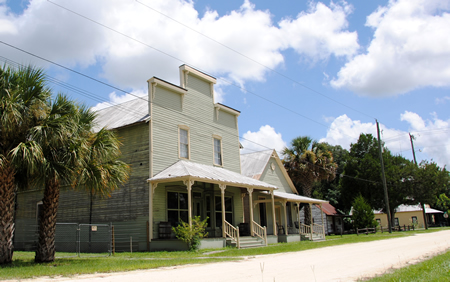
McLeran Store and Cash Mercantile Store

McLeran Store and Cash Mercantile Store


Old McLeran family house

McLeran Store and Cash Mercantile Store


Fisher Cabinets is now located in the former Dave McDonald garage
along the old brick road


The first brick road in Suwannee County


I wish I knew the history behind this amazing house (which is for sale by the way)


Side view of the above house from the realtor.com listing


While not in Wellborn proper, this house is located not far to the northeast of the town.

For more information on Wellborn:

Sunday, June 19, 2016

Luraville and Peacock Springs

Luraville, FL of today is little more than a crossroads with a flashing light, roughly twenty miles southwest of Live Oak, FL in the north Florida county of Suwannee, just north of the Suwannee River. Information about Luraville is limited to say the least. Here’s what I’ve been able to piece together.

While the town of Luraville does not seem to have been founded by Dr. John Calvin Peacock, he appears to have been one of the town’s earliest prominent citizens. He moved there in 1875 (or possibly 1857, as per one of the signs at the Wes Skiles Peacock Springs State Park), where he bought a large tract of land which included the springs now known as Peacock Springs. Peacock was not only a cattle farmer, but also served as a local doctor and preacher. Luraville grew to a population of 75 by 1886, and had both a saw and a grist mill, as well as two churches and four stores. During that time, the springs on the Peacock property became a popular site for locals to relax, and were used as both the location of baptisms and a source of drinking water for the community.


By the 1890s, the town saw a new source of income: phosphate. In order to move the vast quantities of phosphate being quarried from the Mutual Phosphate Mining Company’s mine at Luraville, the Florida Railway extended what became known as the Luraville Branch into the town.


Downtown Luraville, 1890s (source)


Interior of the Luraville General Store, 1890s (source)


Luraville Phosphate Mine, 1892 (source)


Luraville Phosphate Mine, 1908 (source)

Here information on the Peacocks and Luraville pretty much runs dry until the 1950s, when cave divers began exploring the extensive cave system connecting the springs on the Peacock property. In 1985 the property was purchased by the Nature Conservancy. It was later sold to the state of Florida, and opened as a State Park in 1993. The park was initially named Peacock Springs State Park, but the name was changed to Wes Skiles Peacock SpringsState Park to honor cave diver, filmmaker, and springs advocate, Wes Skiles, who died in 2010.

While Wes Skiles Peacock Springs State Park does offer hiking trails, picnicking facilities, and swimming, its main attraction is cave diving. When I was there, I am fairly certain that I was the only person not diving. There is no park staff on site, and the entrance fee is to be paid in accordance with the honor system ($4/car; bring exact change). The only map of the hiking trail is located at the park entrance (which I didn’t realize until I was driving out). There are at least two signs bearing maps of the park’s cave system, although I expect that cave divers need to arrive with far more detailed information. There are two different dive shops in Luraville, which should be able to accommodate cave diver’s needs in that respect.


The roads in the park are not paved.


Peacock Springs


Cave Divers in Peacock Springs


While it was gorgeous, there was a high level of algae growth.


Just down the run from Peacock Springs


Just down the run from Peacock Springs


Orange Grove sink, one of the other springs on the park grounds, is nearly entirely covered with duckweed, except for the areas from which water upwells.

Other than the two dive shops, there is not much to modern day Luraville: one convenience store, a church, a flashing light, a community center, and a handful of homes. Several of the homes clearly date back to Luraville’s heyday, although I would guess that its modern population is somewhere in the vicinity of the community’s 1886 population of 75, if not smaller.


This house dates to the 1930s, and is currently for sale.


I was unable to find any information on this house.


Luraville Community Center and Voting Precinct. The red building in the rear is the Luraville Volunteer Fire Department.


Here's a closeup of the Luraville Community Center. If you scroll up to the picture of downtown Luraville in the 1890s, you will see similar buildings, one of which may very well be this structure. If this is the site of the original downtown Luraville, this is all that remains.
 .
Another old house of Luraville

For more information, check out the following:
Wesley C. Skiles (Wikipedia)